Lockwood Boarding School
Lockwood Boarding School
1930-1960/1964
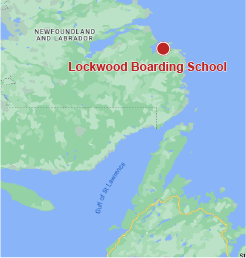
Cartwright, Labrador
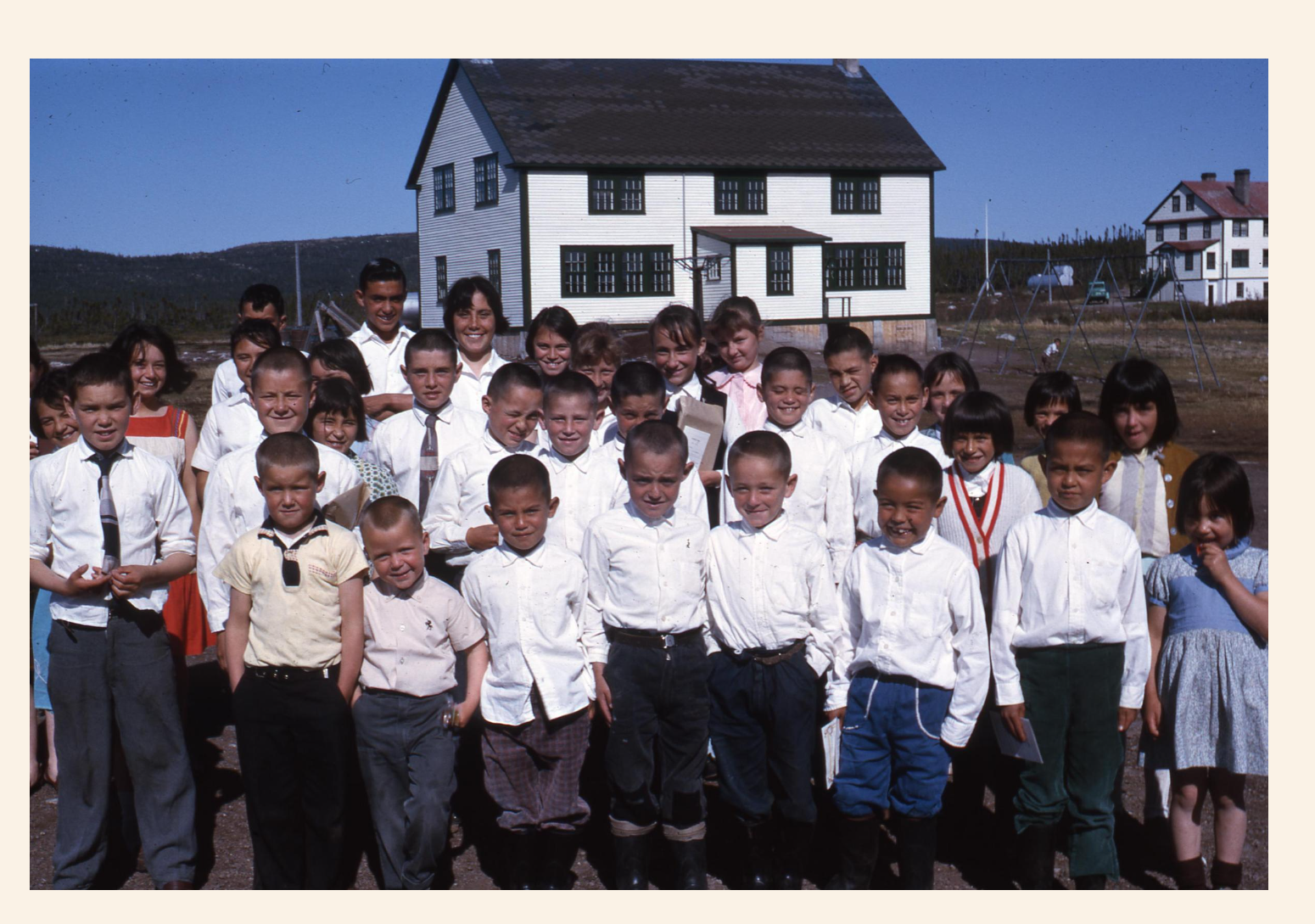
Students, Lockwood Boarding School, 1960s, Them Days Archive
ADMINISTRATION
The Lockwood Boarding School has roots ten kilometres away in the community of Muddy Bay. Anglican missionary Henry Gordon arrived at Muddy Bay in 1915 and began planning for a boarding school to provide Inuit and Labrador Metis children with access to schooling. The 1918-19 flu epidemic killed many in the region, leaving at least forty children without one or both parents and the issue of a boarding school to function became more pressing. The Labrador Public School opened at Muddy Bay in 1919. Two years later, the International Grenfell Association (IGA) took over responsibility for the school. The IGA was a non-profit organization started by the English doctor Wilfred Grenfell to provide medical and educational services to southern Labrador and northern Newfoundland, and was supported by British, American, and Canadian donors and volunteers. In 1928, a fire started by two students levelled the school and residence.2
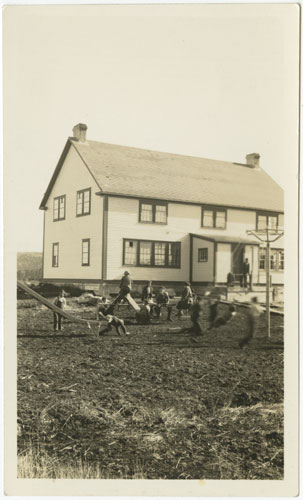
Lockwood School, date unknown, The Rooms Provincial Archive
The IGA decided to build a new school in Cartwright. Named after a key donor, the IGA opened the Lockwood School in late 1930. In 1934, Gordon Hall, the school’s dormitory, burnt down, killing seventeen-year-old student Lizzie Learning, who was in isolation for scarlet fever on the top floor of the building.3 In the interim, before a new boarding facility could be built, the schoolhouse was pressed into service as a combined clothing store, dormitory, hospital, and school until the facility was rebuilt.4 In 1936, both a new residence and the sixteen-room Lady Maclay Cottage Hospital were built at the Lockwood School site.5
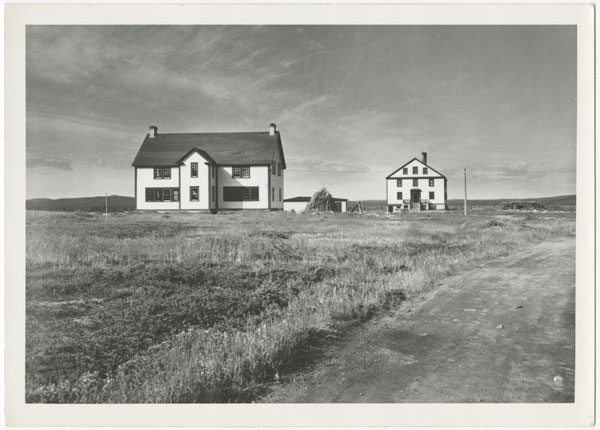
Lockwood School (left) and residence (right). The residence and an on-site cottage hospital were built in 1936, The Rooms Provincial Archive
SCHOOL LIFE
Each year, about 60 children lived at the Lockwood School. They came from small villages in Sandwich Bay, Groswater Bay, Table Bay, Seal Islands, and the Spotted Island/Batteau region. Children arrived at the school for different reasons and at different ages. Some had attended schools in other communities, sometimes boarding with family members, before being sent to Lockwood.6 Others were the children of single parents, and boarding school was determined to be the best care option in lieu of a mother in the home.7 Hazel (Williams) Beaulac was first a patient at the on-site cottage hospital at age four before she began attending the school the next year. For her, the transition to school was different. Because she had been separated from her family at a young age for medical care, she was already estranged from her father and sister when she was transferred from the cottage hospital to the school at age five:
At age five, I started school in Lockwood School but we lived in a hospital that year. And in 1949, I lived in the dorm. I missed the hospital life because they were the only people I knew. I didn’t know my dad. I didn’t know my sister because I didn’t see them. So I remained there in Cartwright till I was eight years old before they let me go home. Then I went to a place where there was just three of us. I didn’t know my dad. I didn’t know my sister, but I got to meet other relatives and I really enjoyed it. Then September came, back to Lockwood again. That’s when the loneliness really set in because I didn’t see my dad probably about once or twice a year. I didn’t make friends. I was scared. I felt I was the youngest one and the smallest one in the dorm with about 30 kids. So that was practically the way it was.8
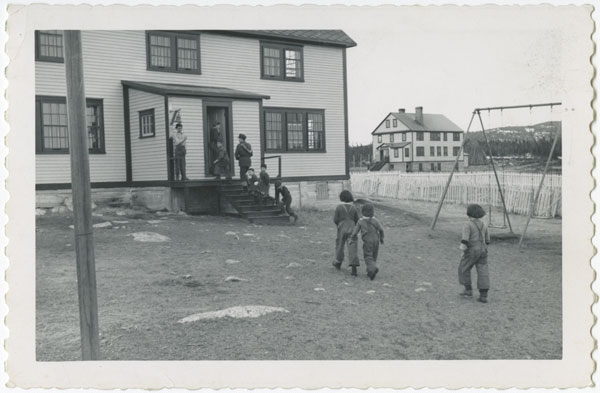
Students on the playground, Lockwood School, The Rooms Provincial Archive
Some students recount feeling excited to leave home in the fall and go to school at Lockwood, not understanding that they would not see their families until June of the following year. Robert Davis recounts that “When the school opened up, Mother and Father asked me if I would like to go to school. I said I’d be glad to go, so a few days later they took me up to Cartwright where I went up to the dormitory. I was the first pupil that went in Lockwood School. That first year we had 15 girls and 13 boys…I stayed there from September to June, didn’t even go home for Christmas.”9 Josie Penny was excited to join her older sister Maisie at school, in spite of her mother’s reluctance for her to leave. “Climbing into the boat, I was too excited to care what my mother was thinking. I had no idea that it would be two years before I would set eyes on my family again – and no notion that the school experience would change my life forever.”10
Survivor accounts detail the difficulties children had adjusting to the regimented life of the boarding schools, which was very different from their family life at home.11 Former students recall the freedom of their childhoods and the extended kin networks that characterized their home communities.12In contrast, their introduction to the regimented schedule of the boarding school is often recalled as brutal and traumatic. Betti Mesher Brookfield recalled of arriving at Lockwood that:
I remember when I got there, our orientation was to have a bath. You got your hair chopped off, your earlobes showing and a bang across your forehead. You were deloused if you had lice or not, swamped with some kind of solution to kill head lice.
You were issued your clothes, which was cotton shirts and peter pan collars with rick rack and a pair of bibbed overalls. I don’t remember if we had our own footwear or not, but I remember having cold feet and being very cold. I was always very cold. I guess I really didn’t have a lot of warm clothes.”13
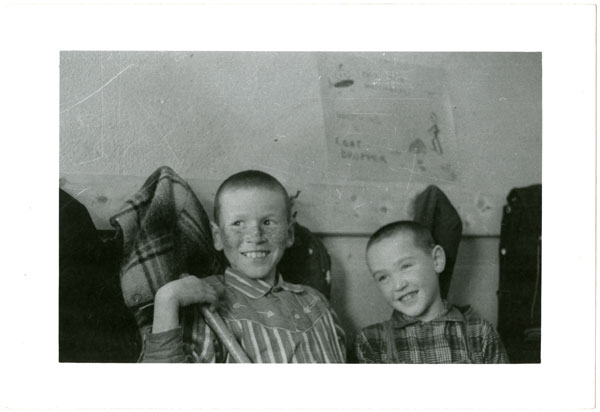 Lockwood Boarding School students Gordon Elson and Raymond Green, The Rooms Provincial Archive
Rosalie Webber, who was a student in the 1940s, recounted in her testimony to the Truth and Reconciliation Commission that “It was very, very traumatic as a child, to go from a homey family environment to a sterile, where you were wakened by a bell, cleaned your teeth by a bell, made your bed by a bell.” She recalled the experience as lonely, confusing, and regimented, leaving her with feelings of humiliation and anger:
So, and then my first meal there I didn’t eat potatoes, well we didn’t have potato peels. Well we didn’t have potatoes in the islands, you know. We didn’t have too much fresh fruit and we ate off the land. Because I didn’t eat my potatoes then I was refused food and I was sent to my room. And it wasn’t my room, it was everybody’s room. And for three days I didn’t have food. And when my meal time came they presented the potato skins to me again and I’d refuse to eat them, till the third day. And, I guess I must have ate them because I was allowed to go back to classroom, or the dormitory. It was a limited, regimented life that left her feeling angry and humiliated: So you grow up, always hungry. You get up by a bell, you ate by a bell, you sat by a bell, you got up by a bell, you went to school by a bell, you come in from out-side by a bell, you had your other meal by a bell and you went to bed by a bell. And when that bell rang there was no communication between anyone; very isolating, very lonely. I was filled with anger that you couldn’t express.14
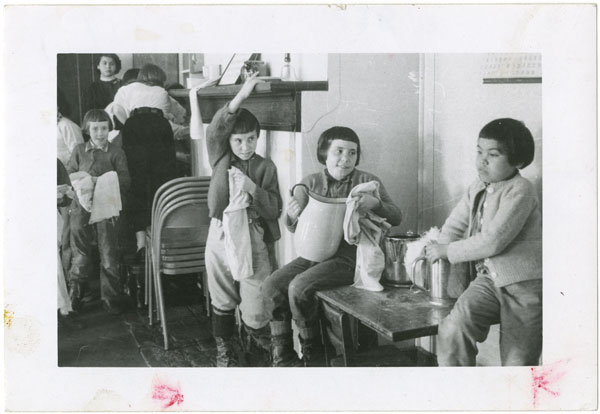
Girls drying dishes, The Rooms Provincial Archive
Although some students recall their time at Lockwood Boarding School fondly, other students report physical abuse, sexual assault, and manual labour. Penny, who attended the school at the same time as two of her sisters, recalled her two years as beginning with excitement that soon changed as she quickly began to experience abuse. Her introduction to the school began with being deloused in a bathtub. As a bedwetter she was shamed, made to sleep in her own urine all night, and periodically placed on the floor or under the stairs to sleep without explanation. She was lonely, separated from her family, teased, and raped by other students. “I lost my sense of compassion and feelings. I didn’t know how to feel. I was afraid to become attached to anything or anybody…. I was very broken by that point on.”15 Student labour was required for the school to operate. Students were responsible for scrubbing floors, washing dishes, shovelling snow, hauling firewood “for the big fireplaces in the hospital, the dormitory, and for the wood stoves in the school.”16
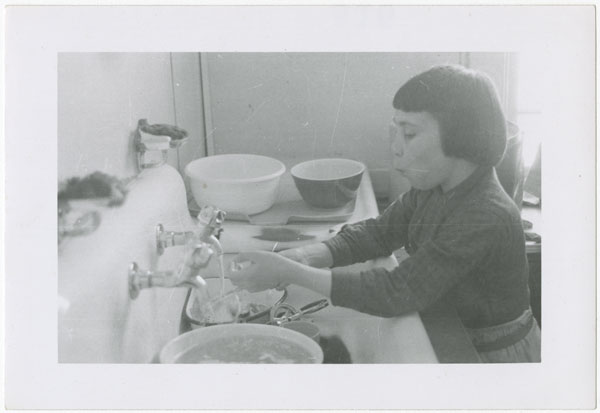 Maggie Dyson washing dishes, The Rooms Provincial Archive
SEPARATION FROM FAMILY
Separation from family and the resulting loneliness characterizes student accounts of their time at Lockwood. Reginald Dyson, who started at the school in 1957 at age twelve, recalled that “because you had to leave home at such a small — young age, five or six years old, leave your mother and fathers and go in that place over there. You didn’t know nobody…You see them like in the wintertime crying ‘Want to go home, want to go home.’ All winter long that was going on, you know.17 Penny snuck into a closet to find her things she brought with her to school to feel connected to her family. “Suffering from a cold one day, I was sent home from school. Feeling lonely in that big dormitory by myself, I decided to do some exploring. I sneaked into the sewing room across the hall and found my own clothes tied neatly in a bundle. I couldn’t believe they were mine. They smelled exactly like home. As I cried out my heartbreak into that bundle, I tried desperately to remember what Mommy and Daddy looked like.”18
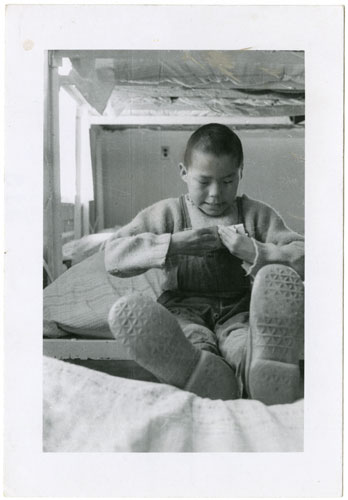
Willie Suarak holding a package, The Rooms Provincial Archive
Some students whose family members were able to make trips to Cartwright got to see family between September and June. Dyson’s father came to Cartwright once a year, in February or March.19 Other students who had family members who lived nearby were able to leave the school at Christmas and Easter to stay with family.20 Other students, however, were prevented from visiting with family. School staff refused to admit Helen William’s father to see her: “There was several times my dad came to see me in the winter. I was in school. They wouldn’t come and get me when he was there. And all I would know was that Charlie Whiskers was there because that’s what they used to call him because he had a beard.”21 Webber was not allowed any contact with her mother, who worked at the school.22 June was the best time of the year, because it meant going home to family for the summer. “Going home on the boat in the spring was a joyous occasion. School was over and we was all going back home! What a wonderful time! We’d get on the boat and we’d be singing, ‘My Bonnie Lies Over the Ocean’ and stuff like that.”23
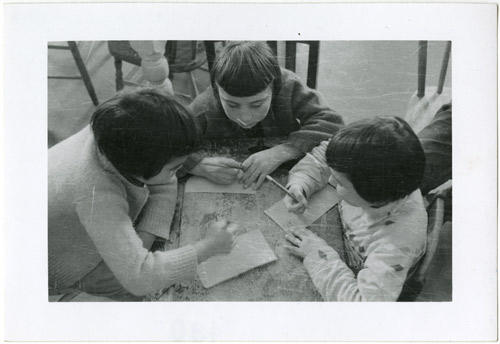
Three girls writing at a table, The Rooms Provincial Archive
The long-term impacts of school life and separation identified by former students are diverse. Helen Williams was called the “farmer’s child” by her family of fishers because “I didn’t know what to do, like my sister did. I didn’t know how to row. I didn’t know what kind of rocks to pick up for the sanding nets.”24 Others point to long-term family alienation because of their years away at school. Penny wrote of her experience that “There’s an indescribable ache to homesickness. It’s aptly named, because you feel ill with longing. I lost the bond with my family. I still don’t know them very well to this day, and I’ve always felt alienated from them. Recently, things are better and I feel closer to my family again, but it’s taken 50 years.”25 Others have been reluctant to speak of their experiences. Ann Noseworthy, who attended the school for seven years, noted only that “It was a nightmare to stay there.” 26
HEALING
In 2019 Cartwright Survivor Ken Mesher told listeners at a commemoration event in Happy Valley-Goose Bay that his school experiences had left him angry and bitter. He shared, however, that “The way of healing is not to hold bitterness, not to be angry…. You’ve got to forgive people that did you wrong. That’s how I started healing, I’m healing and I’m very happy that I had people to support me.”27
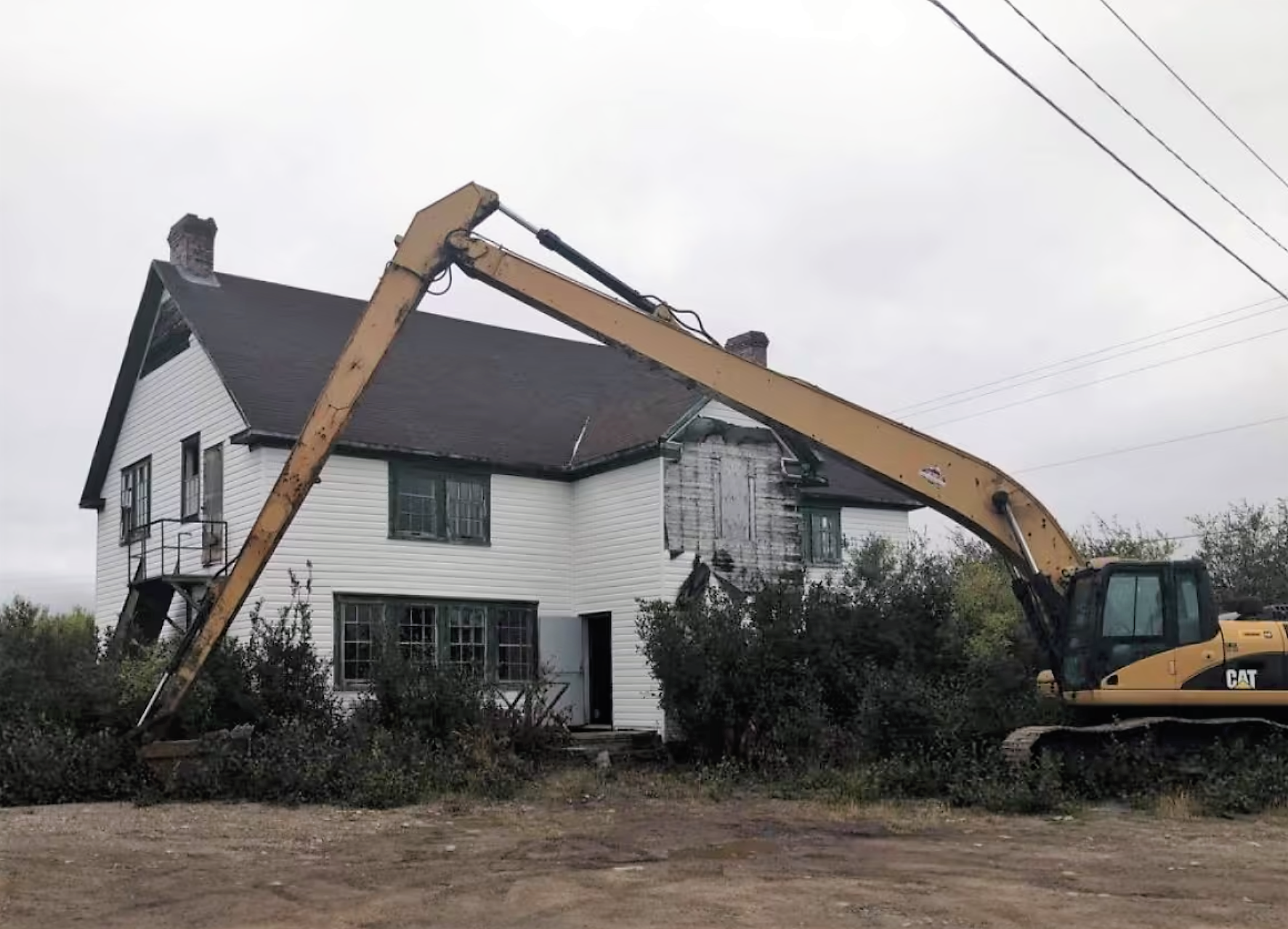
Demolition of the Lockwood school building, 2020, Tyler Mumford via CBC News
Additional Resources
Ressources supplémentaires
Lockwood Cartwright
Apology, given by Prime Minister Justin Trudeau, 24 November 24 2017, Happy Valley-Goose Bay, Newfoundland and Labrador
- English https://pm.gc.ca/en/news/backgrounders/2017/11/24/statement-apology-behalf-government-canada-former-students
- Inuttitut https://pm.gc.ca/en/news/backgrounders/2017/11/24/kaujititsiutik-kakialiutigijaujumut-pijumik-kiggannikut-canadaup
- Innu-Aimun https://pm.gc.ca/en/news/backgrounders/2017/11/24/tshishe-utshimau-aimieu-nenu-ka-utinakananit-katshishkutamuakanishat
Tyler Mugford, We’re still here: How the residential school system affected my family, CBC News, 3 October 2020, https://www.cbc.ca/news/canada/newfoundland-labrador/pov-mugford-residential-schools-1.5745859
The Rooms Provincial Archive, Healing and Commemoration collection, Cartwright, Collection GC 42, Series 2017 – 2019
Most of the interviews contain video, audio, and transcript files
http://gencat.eloquent-systems.com/therooms_permalink.html?key=138759